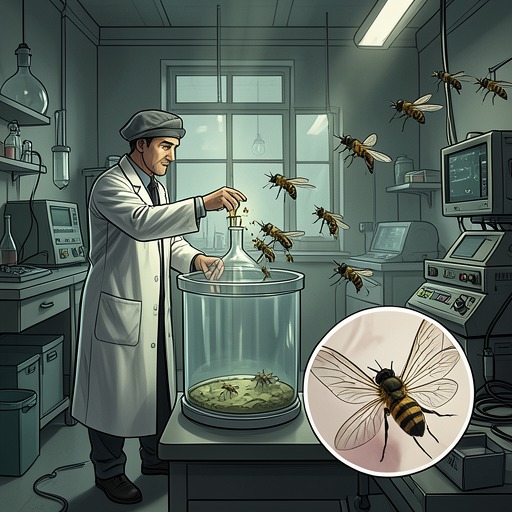
Screw-worm fly
Silent SpringThe screw-worm fly is a tropical and subtropical pest whose larvae develop in the wounds of warm-blooded animals, with serious consequences for livestock and wildlife. After the fly became established in Florida, it spread into neighboring states and imposed large annual costs on the livestock industry. Its story in Silent Spring turns on a consequential reversal: the same biology that made the insect dangerous also made it vulnerable to a carefully designed campaign using irradiated sterile flies rather than broad chemical poisoning.
Biology and range
Females lay eggs in open wounds on warm-blooded animals. The hatching larvae are parasitic, and a heavy infestation could kill a full-grown steer within ten days. The scale of the damage was substantial: annual livestock losses in the United States were estimated at $40 million, while the toll on wildlife was harder to calculate. The scarcity of deer in some parts of Texas was attributed to the fly, though the book presents this as an attribution rather than a measured total.
The species is native to tropical and subtropical parts of South and Central America and Mexico. In the United States it was normally restricted to the Southwest, but around 1933 it was accidentally introduced into Florida. There, the climate allowed it to survive the winter and establish populations. It subsequently spread into southern Alabama and Georgia, bringing the southeastern livestock industry annual losses estimated at $20 million. The contrast between its usual southwestern range and its successful establishment in the Southeast helps explain why eradication became a regional priority.
Research and the Curaçao trial
The approach that ultimately succeeded grew out of basic research. Scientists had reported sterilizing at least a dozen insect species with X-rays or gamma rays, but these remained laboratory experiments rather than practical control methods. Around 1950, Dr. Knipling began a serious effort to turn insect sterilization into a weapon against the screw-worm fly. Agriculture Department scientists in Texas had accumulated extensive information about the insect’s biology, and by 1954, after preliminary field trials on Florida islands, Knipling was ready to test the theory at a larger scale.
For the full-scale test, Knipling arranged with the Dutch government to work on Curaçao, an island in the Caribbean separated from the mainland by at least 50 miles of sea. Beginning in August 1954, flies reared and sterilized at a United States Department of Agriculture laboratory in Florida were flown to the island and released by aircraft. The release rate was about 400 sterile flies per square mile each week.
The trial produced a rapid, measurable change. Egg masses deposited on experimental goats began to decline, and their fertility fell as well. Seven weeks after releases began, every egg examined was infertile; soon, no egg mass could be found, sterile or otherwise. The fly was eradicated on Curaçao. The result showed that the strategy could work beyond the laboratory, and encouraged Florida livestock raisers to seek a comparable campaign at home.
The southeastern eradication campaign
The Florida effort presented a challenge on a far larger scale: the area to be treated was about 300 times the size of Curaçao. In 1957, the United States Department of Agriculture and the State of Florida jointly funded an eradication campaign. Its operations depended on mass production and planned aerial release. A purpose-built fly factory produced about 50 million screw-worm flies each week. Twenty light aircraft flew predetermined routes for five to six hours a day; each carried 1,000 paper cartons containing 200 to 400 irradiated flies apiece.
Weather unexpectedly assisted the campaign. The cold winter of 1957–58 brought freezing temperatures to northern Florida, reducing screw-worm populations and confining them to a smaller area. The program was considered complete after 17 months. By then, 3.5 billion artificially reared and sterilized flies had been released over Florida and parts of Georgia and Alabama. The figures convey both the extraordinary scale of the operation and its dependence on repeated, geographically organized releases rather than a single intervention.
Eradication and significance
The final signs of the pest’s presence dwindled in stages. The last known animal-wound infestation attributable to screw-worms occurred in February 1959. Several adult flies were caught in traps during the following weeks, but after that no trace could be discovered. The book presents the fly’s disappearance from the Southeast as a completed eradication and a demonstration of what scientific creativity could achieve when supported by thorough basic research, persistence, and determination.
The case is significant within the book’s discussion of alternatives to indiscriminate chemical control. The campaign did not rely on poisoning the wider environment; it exploited the reproductive biology of the target insect by releasing sterile members of its own species. The Curaçao trial established the method’s promise, while the much larger southeastern operation tested whether that promise could survive the demands of scale. Its reported success makes the screw-worm fly an example of pest control organized around specific biological knowledge rather than the broad lethal power of chemicals. The account’s closing note also points to the continuing work needed after eradication: a quarantine barrier in Mississippi was intended to prevent the fly from re-entering the region.